Tag Archives: Property rights

International Valuation Standards Still Fall Short on Customary Land

The International Valuation Standards 2028 Exposure Draft makes an important advance by recognising informal, communal, collective and tribal land interests more explicitly than many earlier standards have done. But when viewed through the realities of customary land, it still raises a deeper concern: what happens when a global technical valuation framework tries to make sense of customary land without first understanding what customary land is?

In this episode of The Customary Land Podcast, Spike Boydell reflects on why that matters, why customary land cannot simply be treated as an awkward variation within an inherited valuation system, and why legitimacy, stewardship, authority and intergenerational responsibility must be held before valuation is allowed to arrive.

The episode explores the deeper structural problem of valuation-first thinking in customary, tribal and Indigenous land contexts. It also explains why concepts such as market value, highest and best use, and valuation-date closure may be too narrow when dealing with living relational systems shaped by layered rights, obligation, continuity and customary authority.

Watch or listen.

Or simply search for The Customary Land Podcast in your preferred podcast player.

If you would like a copy of our full submission to the International Valuation Standards Council, or more information about SUITU and the SUITU Governance Integrity Platform, please email:

contact@customarylandsolutions.com
Rethinking mining law on customary land

Fiji is currently reviewing the Mining Act 1965 and the Quarries Act 1939. In this episode of The Customary Land Podcast, I reflect on why that matters for customary landowners, and why compensation, royalties, and consultation are not enough unless legitimacy, stewardship, and long-horizon responsibility come first.

The episode explores the deeper structural mismatch between inherited extractive law and living customary systems, and asks what must be in place before development on customary land can be treated as legitimate at all. It also introduces SUITU and the importance of a governance integrity spine.

The YouTube vodcast version is available here:
https://youtu.be/z2t0FBvdst4

The podcast version is available here:
https://www.thecustomarylandpodcast.com/2122490/episodes/18921346-rethinking-mining-law-on-customary-land

Or simply search for The Customary Land Podcast in your preferred podcast player.

Let’s talk about Customary Land…

So the first episode of The Customary Land Podcast is ‘live’ in your favourite podcast player (or click the link. In this episode we introduce ‘Customary Land’ and use land related Articles from the United Nations Declaration on the Rights of Indigenous Peoples (UN DRIP 2007) to explain its importance in contemporary society. And yes, there is also a video version for those who prefer to watch rather than listen…

15 years on, Siwatibau’s wisdom on land tenure in his SPLTC Symposium welcome address remains as valid as ever.

Transforming Land Conflict – FAO/USP/RICS Foundation South Pacific Land Conflict Symposium Welcome Address by the late Savenaca Siwatibau, Vice Chancellor, University of the South Pacific – 10 April 2002.

The video can also be viewed in YouTube at  https://youtu.be/gvjpFG9mCK0

Caveat: this was recorded live in Fiji in 2002 on VHS – the video aspect is 4:3 and there has been some deterioration in the magnetic tape so please be patient with screen flickers.

The full transcript is available Savenaca Siwatibau – Welcome Address – SPLTC Symposium – Full Transcript (opens PDF).

The Symposium ‘Declaration and Resolutions’ is available her SPLTC Symposium – Official Declaration and Resolutions (opens PDF).

Fiji parties urged to outline land policy ahead of poll – ABC News 24


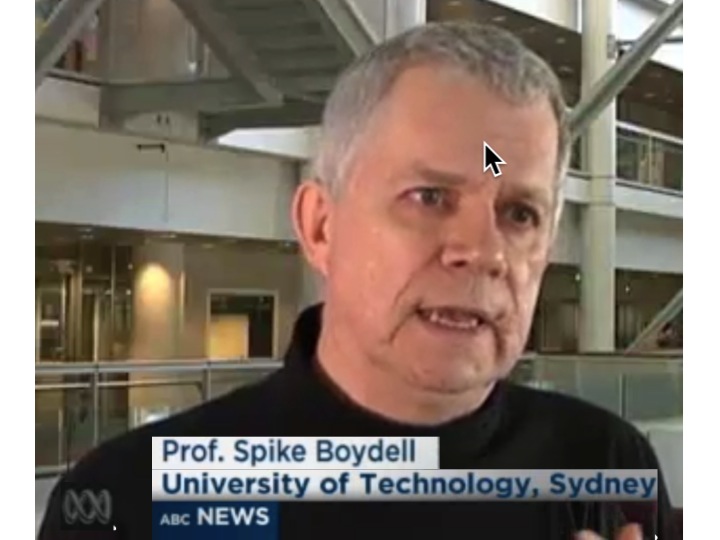
Following on from his 7th June editorial in the Fiji Times, Professor Spike Boydell has been interviewed by ABC correspondent Sean Dorney for this item on ABC News 24 ‘The World’, which first aired on 24 June 2014. It also includes comments from the Attorney General Aiyaz Sayad-Khaiyum and Prof Satish Chand.  The link to the piece on the ABC website is available here.

Boydell ABC with logo“What people want is stability and land is central to that stability.” (Spike Boydell)


Call for Land Policies ahead of Fiji Elections – ABC Pacific Beat

Professor Spike Boydell has been interviewed on ABC Radio Australia about the need for political parties in Fiji to explain their land policies ahead of the elections.  A transcript of the interview is available here.  The full piece on ABC Radio Australia – Pacific Beat – first aired on 24 June 2013 is available here.

Why land is central to Fiji’s future stability

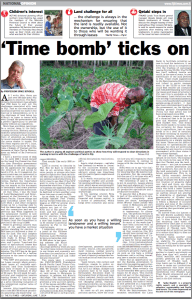
FT 'Time Bomb' imageWith 100 days to go to the Fiji elections in September, none of the political parties have yet explained in their manifesto’s how they will deal with land (indeed, where are the manifesto’s?).  In his feature editorial in the Fiji Times on Saturday 7th June, Spike Boydell highlights that being clear on land issues, having equitable leases that are fit for purpose at market rents, and respecting the paramountcy of iTaukei land – the vanua – is central to long term economic and political stability in Fiji.

Read the full article here.

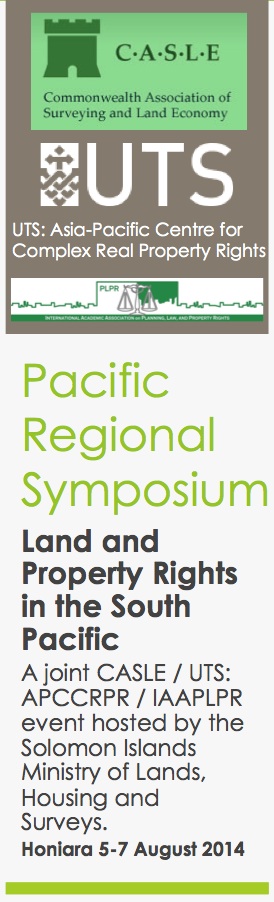
Pacific Regional Symposium – Land and Property Rights in the South Pacific – Honiara 5-7 August 2014

Symposium image flyer

CLS members Spike Boydell, Ulai Baya and John Sheehan are co-facilitating the Pacific Regional Symposium – Land and Property Rights in the South Pacific – Honiara 5-7 August 2014 (flyer & registration form) with Mike McDermott.

This Symposium is a joint initiative of the Commonwealth Association of Surveying and Land Economy (CASLE), the University of Technology, Sydney: Asia-Pacific Centre for Complex Real Property Rights (UTS: APCCRPR) and the International Academic Association for Planning Law and Property Rights (IAAPLPR). It is being hosted by the Solomon Islands Ministry of Lands, Housing and Surveys.  It has been made possible through a small grant from the Commonwealth Foundation and the support of the Ministry of Lands, Housing and Surveys.

This is the second regional Land and Property Rights symposium co-facilitated by the UTS: APCCRPR and the IAAPLPR.

Please click on the highlighted text above, or the image on the left for more information.

The CLS site will be the digital repository for the symposium resources and video record of the event.  If you are unable to attend, but would like to be notified when the resources are online, please complete the following contact form:

← Back

Thank you for your response. ✨

Imagine, if you will, what might change in terms of our identity as citizens if Australia were to become a Republic – something that many see as inevitable, albeit a situation which is yet to become a reality. I’m not talking here about the tokenism of a new flag or a contemporary national anthem, or even in the transfer of proxy leadership from a Governor General as representative of the English Crown to a President as representative of the Federation of States and Territories. Rather, my interest lies in what happens to the superior interest in land and the associated subsidiary property rights when (rather than if) Australia becomes a Republic, and what the ramifications are for notions of identity… if we replace the Crown and the Crown’s superior interest in the land with something, and if that something is an acknowledgement of the guardianship of the land through Aboriginal and Torres Straight Islander stewardship, would this, could this, or should this affect the underlying way that we as 21st century citizens relate to real property.

In his recently published chapter – A 21st Century Citizen in a brave new Republic – Spike Boydell explores how Aboriginal and Torres Strait Islander native title could be prioritised over freehold land if, or when, Australia becomes a Republic.